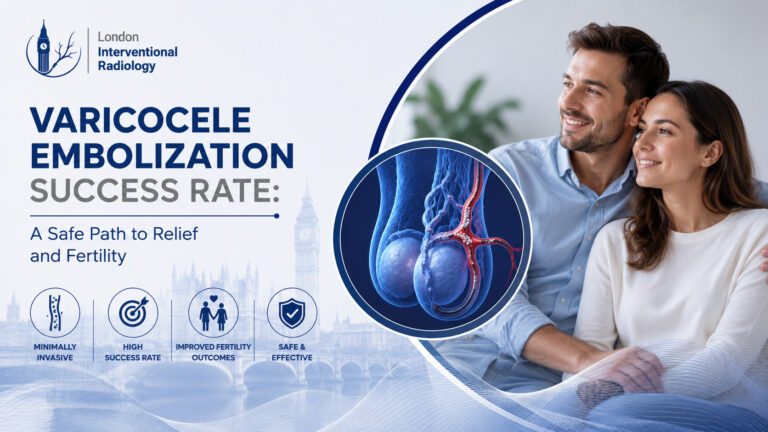
Are you dealing with the nagging discomfort of a scrotal varicocele or struggling with fertility issues? You want a solution, but the idea of “going under the knife” is daunting. You are looking for an effective alternative. By exploring the high varicocele embolization success rate, you will discover how Dr. Samir Abdel Ghaffar can help you treat this condition without the risks of open surgery.
What Is the Real Varicocele Embolization Success Rate?
When patients visit Dr. Samir Abdel Ghaffar, their primary question is almost always about the effectiveness of the procedure. It is a valid concern. You want to know if this treatment will work and if it will last. The current literature and clinical studies are very clear on this: Percutaneous embolization is highly effective.
To understand the numbers, we must distinguish between two types of success:
- Technical Success: This refers to the radiologist successfully accessing the vein and blocking it.
- Clinical Success: This refers to the disappearance of the varicocele, relief from pain, or improvement in sperm parameters.
The technical success rate of varicocele embolization is exceedingly high, often reported between 90% and 95% in established medical centers. This means that in the vast majority of cases, an experienced interventional radiologist can successfully navigate the catheter to the target site.
Regarding clinical success, studies demonstrating long-term outcomes show that varicocele embolization offers success rates that are comparable to the best surgical options. For pain relief, success rates are typically around 85-90%. For fertility, significant improvement in semen parameters is observed in a high percentage of men, leading to increased pregnancy rates for couples.
Varicocele Embolization Recurrence Rate: Is It Durable?
One of the fears surrounding non-surgical treatments is that the problem will come back. However, Percutaneous embolization of the internal spermatic vein has a low recurrence rate when performed by a skilled specialist.
Recurrence usually happens if there are tiny collateral veins that were missed during the initial procedure. The beauty of embolization is that it involves a venogram (an X-ray map of your veins) during the procedure. This allows Dr. Samir to see all the veins, including the hidden collateral ones, and block them effectively.
While older data suggested higher recurrence for embolization compared to microsurgical varicocelectomy, advances in embolic material (like coils and sclerosants) have leveled the playing field. Today, the recurrence rate is generally low, ranging from 5% to 10%, which is very similar to the success rate of surgical procedures. This makes it a durable and reliable option for the long term.
Varicocele Embolization vs. Microsurgery: Weighing the Options
Choosing between surgery and embolization is a major decision. Traditional surgery, specifically open varicocelectomy, involves an incision in the groin, general or spinal anesthesia, and a longer recovery period. Even with the microsurgical approach, which uses a microscope to reduce risks, it is still an invasive operation.
In contrast, embolization is an endovascular procedure. It is minimally invasive. There is no cutting, no stitches, and usually no general anesthesia.
- Safety: Embolization avoids the risks of surgical infection and hydrocele formation (fluid around the testicle), which is a common complication of surgery.
- Efficiency: It is often an outpatient procedure.
- Effectiveness: It provides different success rates depending on the anatomy, but generally, it is comparable to the highest success rates of surgery without the trauma.
For many patients, specifically those with a failed prior surgery (retrograde flow recurrence), embolization is actually the preferred treatment because it tackles the problem from the inside out.
How the Procedure Works: A Technical Description
Let’s demystify the process. Embolization is a transcatheter technique. You lie comfortably on an X-ray table. Dr. Samir applies a local anesthetic to the skin (usually the neck or groin). A thin tube (catheter) is inserted into a vein.
Using real-time imaging, he guides the catheter to the left or right internal spermatic vein. Once in position, he releases coils (tiny metal springs) or a sclerosing agent. This blocks the abnormal blood flow that is causing the pressure and swelling in the scrotum.
The blood flow is then naturally referred (redirected) to other healthy veins. The varicoceles shrink because they are no longer being filled by retrograde blood flow. The entire process typically takes about an hour. It is a testament to how advanced modern medicine has become—treating a physical defect without a single incision.
Varicocele Embolization Benefits Over Surgery
Why are so many men choosing this route? The benefits are substantial and revolve around quality of life.
- Recovery: It is significantly shorter. Most men return to work in 1-2 days.
- Pain: Post-procedural pain is usually mild.
- Anesthesia: It only requires local anesthesia with mild sedation, reducing risks.
- Privacy: No scars on the scrotum or groin.
- Simultaneous Treatment: If you have varicoceles on both sides (bilateral), they can be fixed through the one puncture site. Surgery often requires two incisions.
Impact on Fertility and Semen Parameters
Infertility is a primary driver for seeking treatment. A varicocele raises the temperature of the testicles, which damages sperm production. Does embolization fix this?
Yes. Evidence from numerous published studies confirms that embolization results in significant improvement in sperm count, motility, and morphology.
- Pregnancy Rates: Couples often report achieving pregnancy naturally within 6 to 12 months following the procedure.
- Testosterone: While primarily for fertility, some studies suggest an improvement in testosterone levels in men who had low levels prior to treatment, leading to better overall energy and mood.
The conclusions of the medical community are that embolization is a valid, effective, and safe first-line treatment for infertile men with palpable varicoceles.
Varicocele Embolization Side Effects and Risks
No medical procedure is entirely risk-free, but embolization is considered extremely safe. Complications are rare but can include:
- Minor bruising at the puncture site.
- Mild back pain or flank pain (caused by the vein blocking agents).
- Allergic reaction to the contrast dye (rare).
- Migration of coils: In extremely rare cases, a coil can move. However, experienced interventional radiologists like Dr. Samir use precise sizing techniques to prevent this.
Unlike surgery, there is virtually no risk of testicular artery injury (which causes testicular atrophy) or hydrocele. The safety profile is one of the procedure’s strongest selling points.
Varicocele Embolization Cost
Cost is a factor for many. Generally, the cost of embolization is comparable to surgery. While the materials (catheters, coils) can be expensive, you save significantly on hospital costs because there is no overnight stay, no anesthesiologist fee for general anesthesia, and no operating room rental fees.
When you factor in the quicker return to work (less lost wages), the economic value becomes even clearer. Dr. Samir’s clinic provides transparent pricing structures for patients in both London and Cairo.
Varicocele Embolization Recovery Time
This is where embolization truly shines.
- Day of Procedure: You go home the same day. You might feel some mild cramping.
- Day 1-2: Most men resume normal non-strenuous activities.
- Day 7-10: You can usually return to the gym and full sexual activity.
Compare this to surgical recovery, which often restricts heavy lifting and exercise for 2 to 4 weeks. For men with active jobs or lifestyles, the shorter downtime is a non-negotiable advantage.
Varicocele Embolization Success Rate Reddit and Social Proof
If you search for “varicocele embolization success rate reddit,” you will find hundreds of threads. While anecdotal, these stories are valuable. You will read about men who were terrified of surgery, chose embolization, and were amazed by how simple it was.
Many users report a “night and day” difference in how their scrotum feels—lighter, cooler, and pain-free. While some discuss recurrence, the overwhelming sentiment is positive, with many wishing they had done it sooner. These real-world experiences validate the clinical data.
Varicocele Embolization Success Stories
Let’s look at a typical case. Ahmed, a 32-year-old software engineer, suffered from a dull ache after sitting for long periods. He and his wife had been trying to conceive for two years. His analysis showed low sperm motility. He feared surgery.
He visited Dr. Samir. The procedure took 50 minutes. Ahmed took Tylenol for one day and was back at his desk the next. Three months later, his pain was gone. Six months later, his wife was pregnant. This isn’t just a marketing story; it is a common clinical outcome demonstrating the efficacy of the treatment.
Why Choose an Interventional Radiologist?
Varicocele repair has traditionally been the domain of urologists. However, interventional radiologists (IRs) are the masters of the vascular system. They are the ones trained to navigate wires through tiny vessels using image guidance.
Dr. Samir Abdel Ghaffar is a Consultant Interventional Radiologist with years of experience in treating complex vascular conditions. Whether it is uterine fibroids treated with catheterization or complex varicoceles, his expertise ensures the highest success rates. He uses the most advanced imaging equipment to ensure the embolic material is placed with sub-millimeter precision, ensuring the vein is blocked safely and effectively. 👨⚕️
Frequently Asked Questions (FAQs)
How effective is varicocele embolization?
It is highly effective. Technical success rates are over 90%, with clinical success (symptom relief and varicocele disappearance) ranging from 85% to 90%.
What is the failure rate of varicocele embolization?
The failure rate (technical inability to access the vein) is low, roughly 5%. Recurrence rates are between 5-10%, which is similar to surgery.
Is embolization better than surgery?
“Better” depends on the patient, but embolization is less invasive, has fewer complications, and a faster recovery. It is a superior choice for safety and convenience.
What are the disadvantages of varicocele embolization?
The main disadvantage is exposure to a small amount of X-ray radiation (fluoroscopy) and the slight risk of contrast allergy.
Can varicocele return after embolization?
Yes, recurrence is possible if new collateral veins develop or if a branch was missed, but this is uncommon with experienced operators.
Is embolization a major surgery?
No, it is not surgery at all. It is a minimally invasive percutaneous procedure requiring only a pinhole puncture.
What is the most successful varicocele surgery?
Microsurgical subinguinal varicocelectomy is considered the “gold standard” of surgery, but embolization offers comparable success rates with fewer risks.
What happens if embolization fails?
If it fails technically, surgery is still an option. If it succeeds technically but the varicocele persists, a repeat embolization or surgery can be performed.
Can coils move after embolization?
It is extremely rare. Once the coils induce clotting and scar tissue forms, they are locked in place permanently.
How long does it take for varicocele embolization to work?
The vein is blocked immediately. The varicocele usually shrinks over 4 to 6 weeks. Pain relief is often felt within days.
What is the success rate of embolization surgery?
Technically 90%+, with long-term symptomatic relief in about 85-90% of patients.
Will embolization improve testosterone levels?
Current studies suggest that men with low testosterone due to varicocele often see an increase in levels after repair, improving energy and libido.
Conclusion
You do not have to live with pain or let infertility dictate your future. Varicocele embolization is a standard, effective, and safe alternative to surgery that remains the preferred choice for thousands of men worldwide. 🩺
Under the care of Dr. Samir Abdel Ghaffar, you are in expert hands. Whether you are in the UK or Egypt, relief is just a phone call away.
Contact Dr. Samir Abdel Ghaffar:
🇪🇬 Cairo, Egypt:
- Booking: 00201000881336
WhatsApp: 00201000881336